
eCommerce Development that sells
We don't just build online stores — we build sales machines. Fast, secure eShops with a streamlined checkout, proper SEO, and integration with every sales channel.
An eShop isn't a digital storefront. It's a salesperson working 24/7, 365 days a year, without a break. The question isn't whether you'll "build a site," but whether that site will convert visitors into customers or let them walk away.
The difference between an eShop that sells and one that merely exists lies in the details: loading speed, the path to purchase, the trust it inspires, and the way products appear on Google and social media. We work on precisely these details.
Whether you're starting from scratch or want to upgrade an existing store that isn't performing, we handle the entire project: design, development, payments, shipping, SEO, and integration with your advertising channels. One partner for everything.
And we don't leave you alone after launch. We monitor, optimize, and support you so your store grows alongside your business.
What's included
A complete eShop, ready to sell.
WooCommerce or custom
We choose the right technology for your scale, budget, and needs — without unnecessary complexity.
Speed & mobile-first
Fast loading and a flawless experience on mobile, where the majority of purchases now happen.
Secure checkout
A short, clean purchase flow with secure payments and trust signals that reduce cart abandonment.
SEO-ready structure
Proper category, product, and description structure so customers find you organically on Google.
Channel integration
Product catalogs on Meta & Google, Skroutz/BestPrice, with automatic price & availability updates.
Payments & shipping
Integration with payment providers, cash on delivery, and couriers for smooth, automated operations.
Free guides for your eShop
Free chapters and eBooks from our team. No cost, no strings attached.
 Free eBook
SEO Guide 2026 (free eBook)
A condensed download: SEO today, AI search included, in a PDF you can read in an afternoon.
Read → Free guide
Facebook Ads: the 10 mistakes costing you money
The most common mistakes we see in Meta Ads accounts and how to fix them.
Read → Open course · Greek
SEO Guide: the full course in 11 chapters (Greek)
Our open reference course, readable online chapter by chapter, no email required. Written in Greek.
Read →For advertising the store, see also the eBook The Complete Google Ads System for eShops (€19).
How we work
A clear process, from idea to first sales.
Analysis
We map products, audience & goals and plan the right structure.
Design
We create a design & shopping experience that guides visitors to checkout.
Development
We build the store, payments, shipping & channel integrations.
Launch & growth
We go live, measure, optimize, and provide ongoing support.
Why Qbrains
We build stores that perform.
Conversion-first
Every element is designed to increase sales, not just "look nice."
Measurable from the start
Proper tracking so you know exactly what's working and where to invest.
One partner
Development, SEO & advertising from the same team — no chasing three vendors.
Post-launch support
We're by your side with maintenance, improvements & hosting.
Why most eShops don't sell
The vast majority of online stores fail not because of the product, but because of the experience. Slow loading, confusing navigation, a complicated checkout, and lack of trust drive the customer away at the exact moment they were ready to buy.
We treat the eShop as a journey: from the first click to order completion, every step is designed to reduce friction and increase the likelihood of purchase.
eShop & SEO: the hidden source of sales
Organic traffic is one of the most profitable sources of sales, because you don't pay for each visitor. A properly structured eShop, with clean categories and quality descriptions, steadily builds Google rankings.
That's why SEO isn't an "extra" but a foundation: we integrate it into the store's structure from day one.
Who it's for
From small businesses taking their first steps online to established brands with thousands of products and high traffic, we tailor the solution to your needs. If you're not sure what you need, talk to us and we'll recommend the right approach.
What does the architecture of a modern eShop look like?
An online store is not only the page the customer sees. It is the centre of an ecosystem: the ERP that knows the stock, the payment provider, the couriers, the marketplaces, the measurement tools and the tax authority. Every missing connection becomes manual work every day, and every connection that works properly is hours returned to the business.
What we design before writing a line of code
We map which systems you already have and which is the "source of truth" for each piece of data: if prices live in the ERP, the eShop must not change them; if orders must be invoiced automatically, the invoice is issued by the ERP or an e-invoicing provider and transmitted to myDATA. The names in the diagram, Softone, Entersoft, Pylon, ACS, BOX NOW, Viva, Stripe, are categories of systems we have connected in projects; each integration is designed against your own provider's API and tested on staging before it touches real orders.
Where no ready-made tool exists, we develop custom plugins. At Kiourtsidis.gr that meant our own ERP and a custom plugin feeding 5 marketplaces (Skroutz, BestPrice, Glami, Facebook, Google), and at MediPharmacy.gr a full connection to the pharmacy's ERP.
Checkout, funnels and payments: where are orders lost?
Most orders are not lost on the product page but between the cart and the payment. Hidden shipping costs, forced account creation, a single payment option and a redirect to an unknown page are the classic reasons. Before designing anything, we run a UI/UX check of the existing funnel, step by step, on mobile.
What we build into the checkout
Guest checkout by default, one page with the fewest possible fields, address autofill and a visible total with shipping and delivery time from the cart onwards. For payments we connect what the Greek consumer actually uses: Viva Wallet or Stripe for cards and instalments, PayPal, cash on delivery with the correct fee per courier, bank transfer and IRIS. Every method is tested in sandbox and with a real transaction before launch.
For hero products or campaigns we design custom checkout pages: a one-page funnel with the product, the offer and the payment on the same screen, an order bump before completion and an upsell on the thank-you page. That same thank-you page sends the purchase event to GA4 and Meta, shows the tracking number and invites sign-up, so the order is not the end of the relationship.
Products from Excel, ERP connection, shipping and myDATA: how we automate operations
The real time of an eShop is not lost in design; it is lost in daily administration: entering products, updating prices, issuing invoices, a voucher for every shipment. Our goal is zero double entry.
Product import from Excel and ERP synchronisation
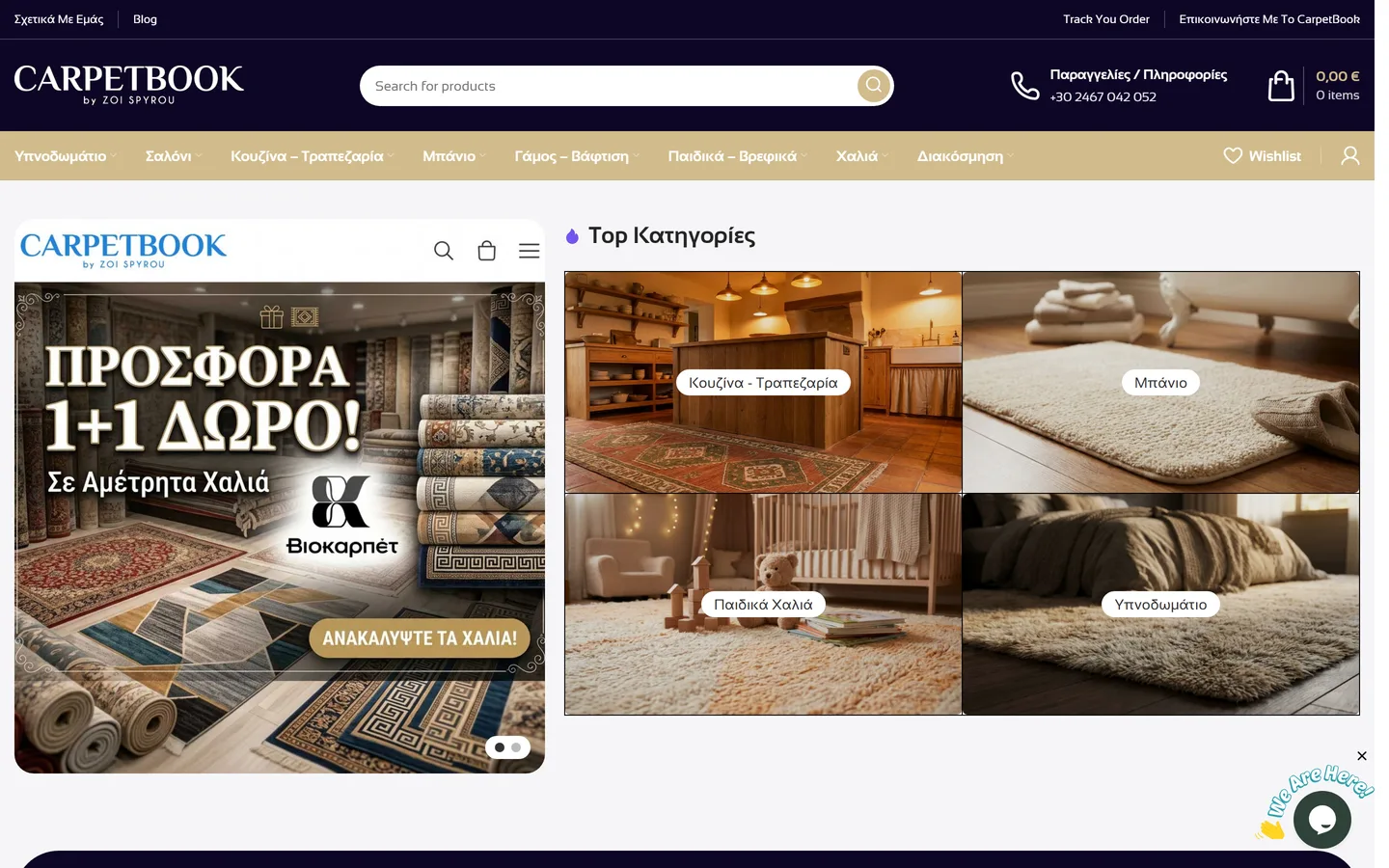
Most suppliers deliver price lists in Excel or CSV. We set up an import with column-to-field mapping, variant handling (size, colour), images from URLs and pricing rules such as a margin per supplier, and schedule it to run automatically. At CarpetBook.gr the products of 10 suppliers are imported this way, with 100% feed automation and zero manual entries. Where an ERP exists, synchronisation is two-way: products, prices and stock from the ERP to the eShop, orders and customers from the eShop to the ERP.
Shipping and invoicing without manual work
Once payment is approved, the order passes to the ERP, the invoice is issued and transmitted to myDATA (the Greek tax authority platform) by the ERP itself or a certified e-invoicing provider. The courier voucher, ACS, BOX NOW, ELTA Courier or Speedex, is issued from the admin in one click or automatically, the customer receives an email or SMS with the tracking number and the order status updates on its own. For BOX NOW, the customer picks a locker on a map inside the checkout. Whatever is not covered by an existing plugin, we build.
Google Analytics 4, Pixels, Conversions API and conversion funnel tracking
An eShop without proper measurement advertises blind. Before launch we set up the whole data flow, so that from the very first order you know where it came from, what it cost and at which step you lose the rest.
What is included
Google Tag Manager with a full eCommerce dataLayer: view_item, add_to_cart, begin_checkout, add_payment_info and purchase with value, items and transaction_id. GA4 with the funnel reports that show abandonment per step. Google Ads with Enhanced Conversions, so Smart Bidding sees the sales cookies lose. Meta Pixel in the browser and Conversions API from the server, with a shared event_id for deduplication and hashed customer data for a high Event Match Quality, all in the same Dataset. Consent Mode v2 wired to the cookie banner, so measurement is both lawful and as complete as possible.
Conversion funnel tracking is not a luxury for big stores. It is how you answer questions like "why do I get visits but no sales" with numbers, and put your Google and Meta budget where it returns.
SEO for eShops and feeds to Skroutz and BestPrice
Organic traffic is an eShop's cheapest sales channel, and the easiest to break: filters that generate thousands of duplicate URLs, categories without copy, products with the supplier's description. SEO is built into the store structure from day one, not bolted on afterwards.
A structure that ranks
Category pages are the ones that win generic searches, so they get unique copy, proper titles and internal links from the blog. Filters (faceted navigation) point a canonical to the category and noindex to combinations with no demand, so crawl budget is not wasted. Every product carries Product schema with price, availability and reviews, which earns rich results on Google and makes products readable by AI engines.
Feeds that do not break
The same catalogue is exported automatically as XML for Skroutz and BestPrice, as a feed for Google Merchant Center and as a catalogue for Meta, each with its own specification and category mapping. Price and availability update on every change, because a mismatch between the feed and the product page means exclusion from the marketplace.
Speed, Core Web Vitals, database, security and backups
A store with a few products is easy to keep fast. A store with thousands of SKUs, variants and filters stays fast only if the infrastructure is designed for it: from how the database is structured to where images are served from.
Performance
Nginx with HTTP/2 and page cache for categories and products, PHP-FPM with Redis object cache for cart and checkout, MySQL with proper indexes and HPOS (High-Performance Order Storage) in WooCommerce, WebP images from a CDN. We measure Core Web Vitals, LCP, INP and CLS, on real users from Search Console and not only in lab scores. At Klonaras the eShop load time dropped from 6 to 2 seconds, and at Homewear.gr Meta Ads brought +69% orders on top of a store that now loads fast.
Security and continuity
SSL, two-factor admin login, login attempt limits, WAF and updates tested on staging first. Two-level backups, daily and offsite, with restore tests, because a backup that has never been restored is a wish, not a plan. At Ekdoseis Pigi 100% of projects have automatic two-level backups (Amazon and local cloud). Hosting and support are ours, so you never chase three vendors when something goes wrong.
How much does eCommerce development cost?
We do not quote a "package" price, because two stores with the same number of products can differ widely in cost: one needs an ERP connection, three couriers and three languages, the other a clean WooCommerce with Viva and ACS. What we can tell you precisely is what shapes the price.
How the quote is built
After a short analysis we record the catalogue, the integrations, payments and shipping, the content that exists and what must be produced, and whether there is a migration from an old store with products, customers, orders and 301 redirects. The quote itemises each part with a timeline and milestones, so you can remove or postpone whatever is not needed in the first phase. The store, the code and your data belong entirely to you. Hosting and support have published prices; for development, request a quote and you will receive a detailed proposal.
Our work in practice
Related case studies with real, measurable results.


Frequently asked questions
eCommerce development.
WooCommerce or custom solution?
Can you migrate my existing eShop?
Does it integrate with Skroutz/BestPrice & Meta/Google?
How long does the build take?
Do you also handle advertising?
What about hosting & support?
Does the eShop connect to my ERP (Softone, Entersoft, Pylon)?
How does product import from Excel work?
What about myDATA and invoicing?
What our clients say
Η συνεργασία μας με την Qbrains (και προσωπικά με τον Ηρακλή) αποτελεί καθοριστικό παράγοντα για την άρτια λειτουργία του ηλεκτρονικού μας καταστήματος. Ως επιχείρηση που λειτουργεί με γνώμονα τη διαχρονικότητα και τον απόλυτο έλεγχο ποιότητας από το 1966, αναζητούμε το ίδιο επίπεδο ακρίβειας και από τους συνεργάτες μας. Η ομάδα της Qbrains παρέχει εξαιρετική τεχνική υποστήριξη, ταχύτατη ανταπόκριση και κορυφαία τεχνογνωσία. Ένας πραγματικά στρατηγικός συνεργάτης που συνιστούμε ανεπιφύλακτα.
Γνώστες του development και τεχνικής υποστήριξης ακόμη και σε custom eshops με αρκετές δυσκολίες όπως το δικό μας. Με υπομονή και επεξήγηση σου δείχνουν το πρόβλημα και προτείνουν την λύση.
Μετά από 7 μηνες συνεργασίας μπορώ να πω ότι ότι λένε το τηρούν (έχουν δει πολλά τα μάτια μου εκεί εξω) Υπάρχει ένα πολύ καλό επίπεδο συνεννόησης που είναι τρομερά σημαντικό ιδιαίτερα σε περίπτωση ανάγκης. Αξίζει κάποιος να συνεργαστεί με την εταιρεία
Αυτο το team εργάζεται σε ένα άλλο επίπεδο ! Φιλική προσέγγιση ,κατανόηση των αναγκών του πελάτη ,άμεση επίλυση των προβλημάτων που προκύπτουν και πολύ καλές τιμές . Συγχαρητήρια τους συστήνω ανεπιφύλακτα !
Άψογη και ταχύτατη εξυπηρέτηση 24/7 ακόμα και μέσα στην καρδιά του καλοκαιριού. Η συνεργασία μας κρατάει σχεδόν 10 χρόνια και ελπίζω για ακόμα περισσότερα.
Πολύ καλοί στον Προγραμματισμό και την Διαχείριση.
Related articles
From our blog (articles are in Greek).
 Business advice
Δημιουργία eshop με αυξημένες πωλήσεις – Αναλυτικός οδηγός
Η δημιουργία eshop αποτελεί μία από τις πιο αποδοτικές επενδύσεις για μια επιχείρηση στον τομέα του εμπορίου. Μάλιστα, το ποσοστό των αγοραστών που επιλέγουν πλ…
Read →12 September 2024 Business advice
Γιατί η ιστοσελίδα μου δεν εμφανίζεται στην Google;
Γιατί η ιστοσελίδα μου δεν εμφανίζεται στην Google; Ένα ερώτημα για αρκετούς ιδιοκτήτες ιστοσελίδων, το οποίο για να απαντηθεί, απαιτεί την εξέταση αρκετών επιμ…
Read →12 February 2024 Business advice
Κατασκευή ιστοσελίδας: Τα 4 πιο συχνά λάθη που γίνονται και πώς να τα αποφύγετε
Η κατασκευή ιστοσελίδας είναι μία διαδικασία που κάνουν όλες οι επιχειρήσεις που θέλουν να έχουν μία ισχυρή παρουσία στο διαδίκτυο.Μία ιστοσελίδα που θα αντικατ…
Read →22 November 2022