
 Hotel
Hotel Hotels · SEO & GEO
Hotel SEO in Greece: from the destination search to the direct booking
Be found by the traveller before they find the OTA. Destination searches on Google, Google Business Profile and Maps, multilingual SEO per market and visibility in ChatGPT, Gemini and Perplexity, all with one goal: bookings from your own website, commission-free.
Google Business Profile & Maps hreflang per market GEO for ChatGPT & Gemini
658,259keywords on page 1
26years of experience
Hotel SEO is the work that makes your property appear on Google, on the maps and in AI engines when a traveller searches for "hotel + destination", "where to stay in Thassos" or, at the end, your own name. It differs from the SEO of an online shop or a clinic in one critical respect: in the results you compete against the OTAs that sell your own room.
The results page for "Halkidiki hotel" shows, together, an AI Overview, the Google Hotel Ads price box, the map with Google Business Profiles, Booking.com and Expedia and, somewhere, the websites of the properties themselves. A hotelier who sees SEO as "getting higher on Google" is missing half the game. The right question is: which of those positions do I control, and how do I fill them with my own rate and my own booking button?
At Qbrains we have done SEO for tourism businesses since 2000, from city hotels such as The Met Hotel and Porto Palace to seasonal properties such as Lobelia Luxury Suites in Thassos. Below we explain what the traveller searches for, what you control on the results page, how multilingual SEO is built per market, what changes with GEO and how the result is measured in bookings.
What does the traveller see when searching "Halkidiki hotel"?
The results page for a hotel query is the busiest on Google. From top to bottom: often an AI Overview summarising "the best hotels" with citations. Then the Hotel Ads box, Google's metasearch, where properties appear with a nightly rate and dates, and next to each rate the seller: Booking.com, Expedia or the hotel itself. Next the map pack, three Google Business Profiles with stars, reviews and photos. And only then the classic organic results, where the top positions are usually held by OTAs with their "hotels in Halkidiki" pages.
What matters is who controls each zone. You control the Hotel Ads box only if your booking engine sends rates to Google, through Hotel Ads and Free Booking Links. You control the map through your Google Business Profile and reviews. You control the organic result with your website. You control the AI Overview partly, through the content and citations we cover under GEO. You do not control the OTAs, but the stronger the rest is, the less room you leave them.
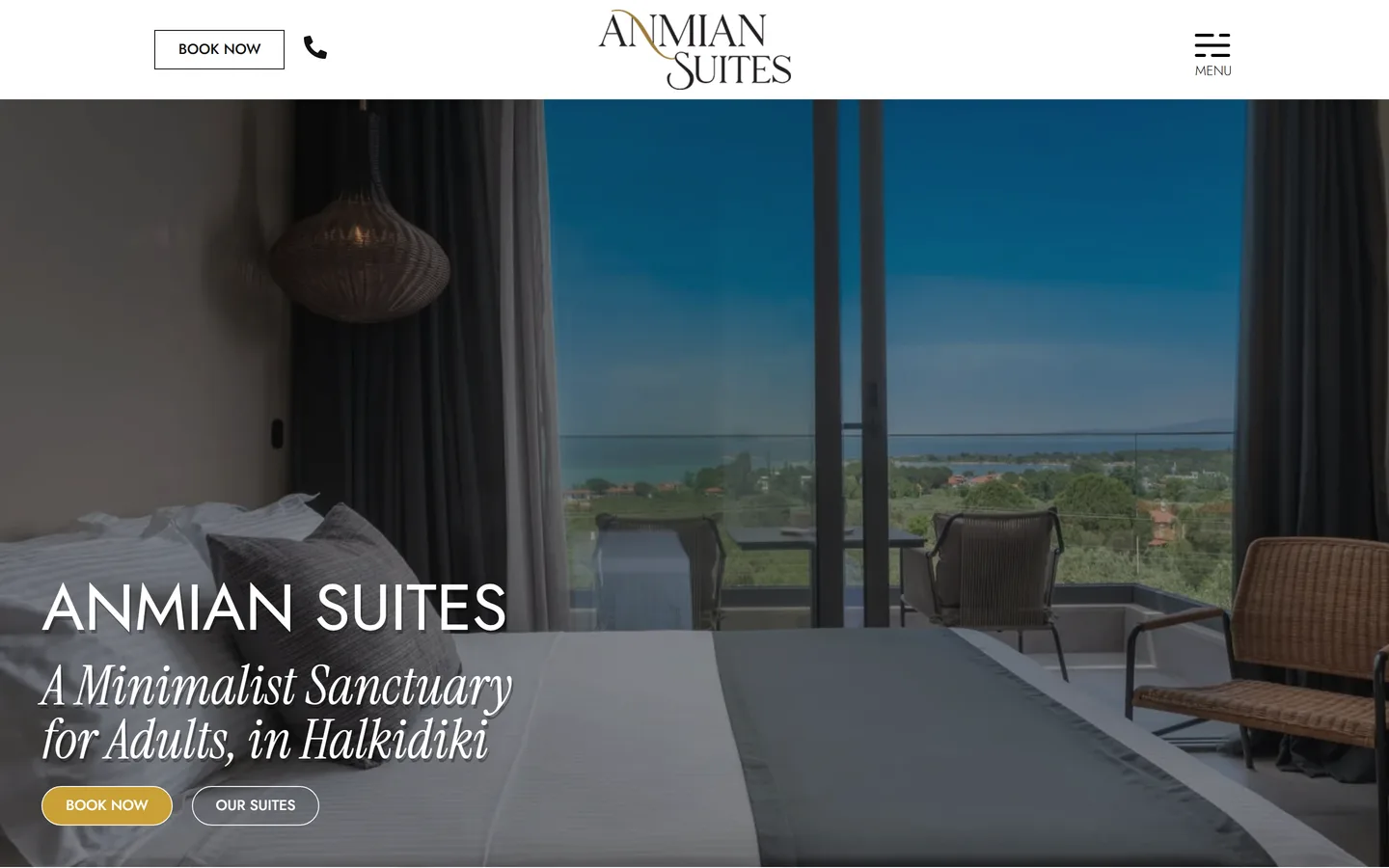
And then there is the search for your own name, the most valuable of all. The traveller saw you on Booking.com, opened a new tab and typed "Anmian Suites". If the first thing they see there is an OTA ad, and your website has no clear rate and booking button, you pay commission on a guest you had already won. The brand results page has to be yours end to end: organic listing, Business Profile, Free Booking Links, sitelinks.
What does the traveller search for, and at which stage?
Hotel SEO is not one battle. It is three, and each one needs different pages.
1. Destination discovery
"Where to go on holiday in September", "quiet beaches in Thassos", "Halkidiki with kids". The traveller does not know you exist yet. They find you only if you have written something about your destination worth reading: beach guides, access from the airport and the port, excursions, seasons.
2. Accommodation search
"Thassos hotel with pool", "boutique hotel Limenaria", "hotel near Skala Prinos port". This is where the structure of your room, amenity and location pages, your Google Business Profile and your reviews are judged. And this is where you compete head-on with the OTAs.
3. Brand search
"Lobelia Luxury Suites", "Moderi Thassos reviews", "Anmian Suites prices". The person has decided and is comparing where to pay. The brand results page must show your site first, with rate, availability and a clear benefit for booking direct.
How does Google Business Profile work for a hotel?
For many travellers the first contact with your property is not your website but your listing on the maps. A hotel's Google Business Profile has particularities a shop does not: the category (Hotel, Resort, Bed & Breakfast, Guest house) defines which searches you appear in, the hotel attributes (pool, breakfast, parking, pets, accessibility) answer the user's filters, and the price box inside the profile is not filled in by hand: it is fed by Hotel Ads and Free Booking Links. A profile without your own rate shows only OTA rates, inside your own listing.
Reviews are part of your SEO, not a separate topic. They influence your position in the map pack together with proximity to the point the user is searching around and the relevance of your category. Above all they influence the click: between three properties at a similar price, the traveller opens the one with the most recent and most detailed reviews. We set up a process so that satisfied guests leave a review on Google and not only on Booking.com, and we answer every review, especially the negative ones, in a way that reads well to the next prospect.
The same profile needs photos refreshed every season, up-to-date reception hours and an operating period for seasonal properties, answers in the questions section and a link to your booking engine. Our local SEO service covers the basics; for hotels we apply them with the particularities described here.
How is multilingual SEO built per market?
A Greek property sells to Germans, Britons, Italians, Serbs, Bulgarians and Romanians, and each market searches in its own language: "Hotel Thassos mit Pool", "Halkidiki beachfront hotel", "hotel Tasos". Your website needs separate URLs per language, with a real translation by someone who knows tourism, its own title, meta description and location content, and hreflang tags that tell Google the /de/ room page is the German version of the /en/ and the Greek one. Without hreflang, translated pages get mixed up and the German visitor sees the English result, or none.
For most properties we recommend subdirectories (myhotel.gr/de/) rather than separate domains per country, so that link equity accumulates on one domain. We set x-default to the English version for visitors from markets you do not cover, and keep the same URL structure across languages so that hreflang is reciprocal and generated automatically. The Balkan markets deserve particular attention in Northern Greece: road access, demand on weekends and public holidays, and less OTA competition in the local languages.
Multilingual SEO also means a multilingual Google Business Profile, reviews answered in the guest's language and location pages answering each market's questions: the German asks about flights to Kavala, the Serb about the border and driving time.
What is GEO and how does a hotel appear in ChatGPT?
More and more travellers do not type "Thassos hotel" into Google. They ask ChatGPT, Gemini or Perplexity: "where should I stay in Thassos with two kids, near a quiet beach, under 150 euros a night". And Google itself now answers with AI Overviews above the results. GEO (Generative Engine Optimization) is the work that makes your property appear inside those answers, by name and with a link.
These engines do not "rank" pages. They retrieve information from sources they trust and compose an answer. For a hotel the sources are specific: your website (especially pages with clear, short answers about location, amenities, room types and policies), your Google Business Profile and its reviews, Booking.com and TripAdvisor, and travel articles or guides that mention you. If the sources say the same thing in the same way, the engine cites you with confidence. If your name is spelled three different ways and the amenities differ per platform, it skips you.
In practice, GEO for a hotel means: question-and-answer sections on your site with FAQPage schema, Hotel or LodgingBusiness structured data with address, coordinates, amenities and room types, consistent details on every platform, and destination content worth quoting. It is the natural continuation of SEO, not something separate.
Which technical problems do hotel websites have?
Six we find in almost every technical audit of a hotel site, and all of them are fixable.
Booking engine in JavaScript or an iframe
Rates, availability and room descriptions that load only via JavaScript from a third-party domain are not read properly by Google. Room pages must carry their content in the HTML of your own website, with the booking engine starting from there.
Duplicate room pages
Ten room types with the same description and a different title, or the same page reachable with date parameters in the URL, spread equity across copies. They need unique descriptions, canonical URLs and proper parameter handling.
Slow galleries on mobile
Photo galleries are the most common reason a hotel site fails Core Web Vitals. Modern formats, correct dimensions, lazy loading and fast hosting solve it without sacrificing image quality.
Missing Hotel schema
Without Hotel or LodgingBusiness structured data, with address, coordinates, amenities, room types and rating, Google and the AI engines guess what you are. We add it to every page, together with FAQPage and BreadcrumbList.
Broken hreflang
Hreflang pointing to pages that do not exist, not reciprocal, or missing x-default. Google then ignores it entirely. We check it page by page in Search Console and fix it at template level.
No location page
"Location" is a map with no text. Yet searches like "hotel near the port" or "how far from the airport" need real distances, travel times, transport options and the points of interest around you, in every language.
Free for hotels & accommodation
Free destination visibility audit
Within 48 hours we send you what the traveller sees when searching for “hotel + your destination” on Google, on the maps and in ChatGPT, and where you are missing.
What you get
- Your destination results page: which of the five zones you appear in and which the OTAs hold
- Google Business Profile check: category, attributes, reviews, rates inside the profile
- What ChatGPT, Gemini and Perplexity answer to “where should I stay in…” and whether they cite you
- hreflang and Hotel schema check on the languages you already have
When should a seasonal property publish its content?
Search demand has a calendar. Searches for "Thassos hotel" from Germany and the UK rise from January, peak in spring and fall once arrivals begin. Greek searches come later, peaking in May and June with a second wave before the mid-August holiday. Google needs weeks to index and evaluate a new page, and months to move it up. So the "Thassos beaches for families" page that will bring visitors in February has to be published in autumn.
That is why we run hotel SEO on an annual content plan: in September and October, when the season ends and fresh Search Console data is available, we decide what gets written. From October to December the destination pages and the refreshed room and amenity pages go live. From January to March we update rates, operating periods, early-booking offers and the Google Business Profile. During the season the weight shifts to reviews, photos and measurement. A city hotel has a smoother curve, with peaks around trade fairs and conferences, so its plan is written around the city's events calendar.
How do we work on a hotel's SEO?
Six steps, from the audit to a monthly report in bookings.
1
Visibility & competition audit
We record the results page for your destination terms and for your name, what your Google Business Profile shows, what the AI engines say, and where the OTAs and competing properties sit. In parallel we run a technical audit of the website and the booking engine.
2
Keyword map per market
Separate research for every language: what the German types, what the Briton types, what the Serb types, and at which stage. Every term is mapped to one page, so that two pages never compete for the same thing.
3
Technical fixes
Speed and Core Web Vitals, canonicals and parameters, hreflang, Hotel and FAQPage schema, proper booking-engine integration, sitemap per language. If the website cannot take the fixes, we say so clearly and look at a new hotel website.
4
Destination & room content
Room and amenity pages with unique copy, location and destination pages with real usefulness, question-and-answer sections. Written or edited by a person, in every language, on the publishing calendar described above.
5
Google Business Profile, reviews & GEO
A complete profile with category, attributes, seasonal photos and a link to the booking engine. A review-collection process on Google, answers to every review, consistent details on Booking.com and TripAdvisor.
6
Measurement in bookings
Search Console for impressions and clicks per term and country, GA4 with cross-domain tracking into the booking engine for bookings and revenue from organic traffic, separately for your name and for destination terms. Monthly report and a plan review after every season.
How do we measure whether SEO brings bookings?
"Positions on Google" are an intermediate indicator. The hotelier pays for bookings. Google Search Console tells us which searches you appear for, in which position, with how many clicks and from which country, and lets us separate searches for your name (which show whether you own the brand results page) from destination searches (which show whether you are winning new guests). GA4, configured with cross-domain tracking so the move to the booking engine does not count as a new visit, records the booking-flow events: availability search, room selection, booking start and completion, with its value.
The monthly report therefore answers real questions: how many bookings and how much revenue came from organic search, from which language and market, which pages brought them, and how their cost compares with the commission you would have paid the OTA for the same bookings. If SEO brings visits that never reach the booking engine, the problem is in the page or the booking flow, and we see it in the same data. See how we work on the booking flow and direct bookings.
Be found by the traveller before they find the OTA
Request an SEO & GEO proposal for your property, based on your destination, your languages and the markets that matter to you.
Request a Proposal →Frequently asked questions about hotel SEO
What hoteliers ask us before we start.
Why does a hotel that is already on Booking.com need SEO?
Because Booking.com gives you visibility but keeps 15% to 25% of every booking and, above all, appears above you even when the traveller searches for your hotel by name. SEO makes your own website the first result for your name and puts it in the conversation for destination searches. The guest who discovered you on the OTA then books directly with you instead of paying the commission on your behalf.
How long does hotel SEO take to bring bookings?
Fixes to your Google Business Profile and to the search for your own name pay off within a few weeks. Destination searches such as "Halkidiki hotel with pool" take months, because you compete with OTAs and with properties that have years of content behind them. Since demand for summer holidays starts in January, SEO set up in autumn and winter is ready for the next season. SEO that starts in June works for the season after that.
What is GEO and how does a hotel appear in ChatGPT?
GEO (Generative Engine Optimization) is the work that makes ChatGPT, Gemini, Perplexity and Google AI Overviews mention your property when a traveller asks "where should I stay in Thassos with kids". These engines compose answers from sources they trust: your website, your Google Business Profile, reviews, OTAs and travel articles. GEO makes sure clear, current and consistent information about you exists in all of them. It is the natural continuation of SEO, not a separate discipline.
Do I need a separate page for every language?
Yes. Every target market needs its own URLs (for example /de/ for Germany and Austria, /en/ for the UK and international guests) with a real translation, its own title and meta description, and correct hreflang tags declaring which page is the equivalent of which. Automatic translation on a single URL, or a widget that switches the language without changing the address, gives Google nothing to index per country.
How do you measure whether SEO brings bookings and not just visits?
With two tools working together. Google Search Console shows which searches you appear for, in which position and with how many clicks, separately for your brand name and for destination terms. GA4, configured with cross-domain tracking into your booking engine, records which organic visits reached room selection and which completed a booking, with its value. The monthly report therefore talks about bookings and revenue, not rankings.
Does my hotel need a blog?
You need destination pages, not necessarily a "blog". A guide to the beaches of Thassos, a page on how to get there from Kavala airport or an article on what to do in Halkidiki in September answer the inspiration-phase search, when the traveller does not yet know where they will stay. A few well-written, regularly updated pages are worth more than weekly articles with no substance.
Can SEO work together with Google Hotel Ads?
It not only can, it must. On a hotel results page the organic listing, the Google Business Profile, Free Booking Links and Hotel Ads all appear on the same screen. The more of those positions show you with your own rate, the less room is left for the OTA. See how we set up hotel advertising with Google Hotel Ads.
Our hotel projects
Properties in Thassos for which we have delivered the website, hosting or SEO.
Hotel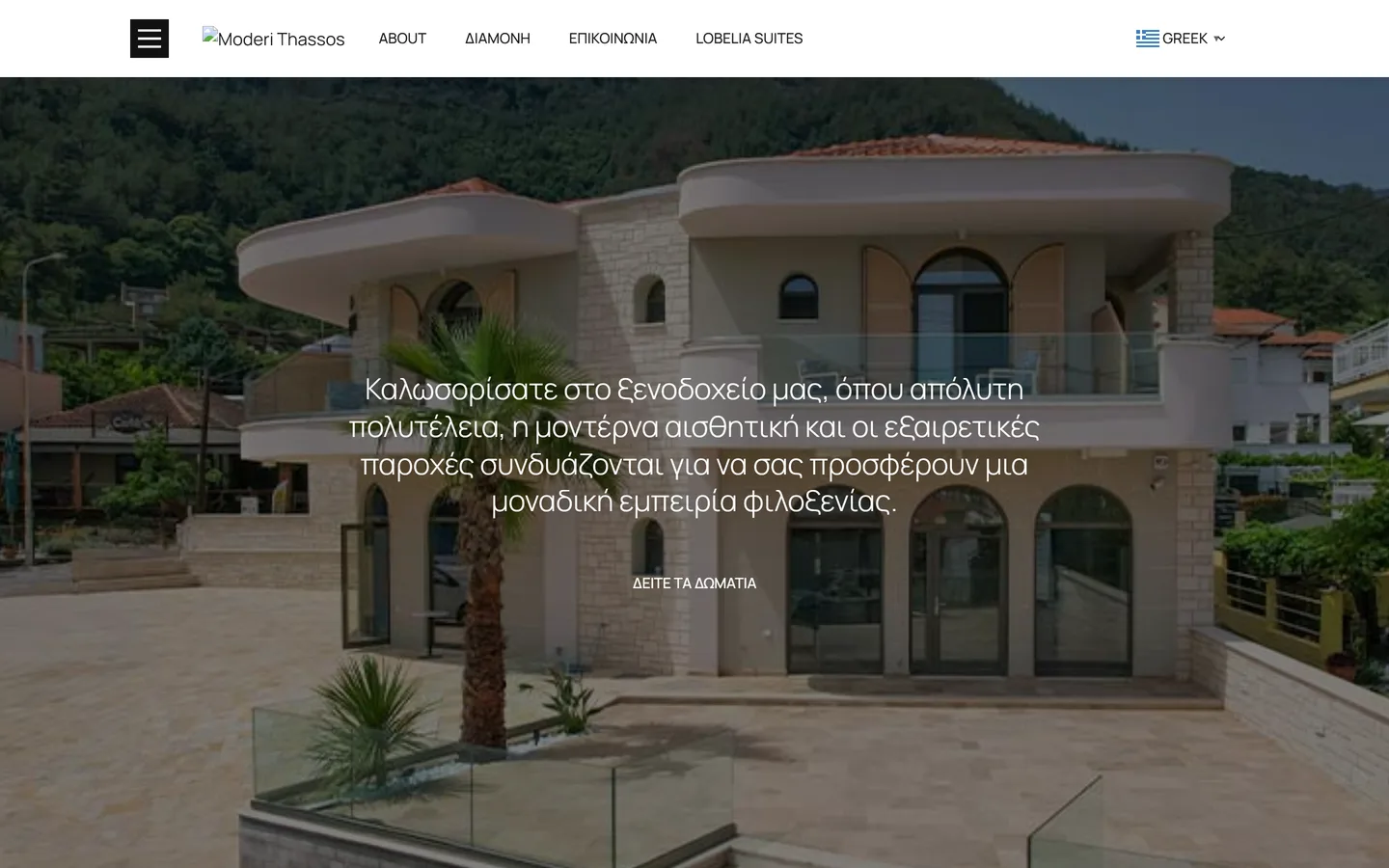 Accommodation
Moderi Thassos
Website & fast VPS hosting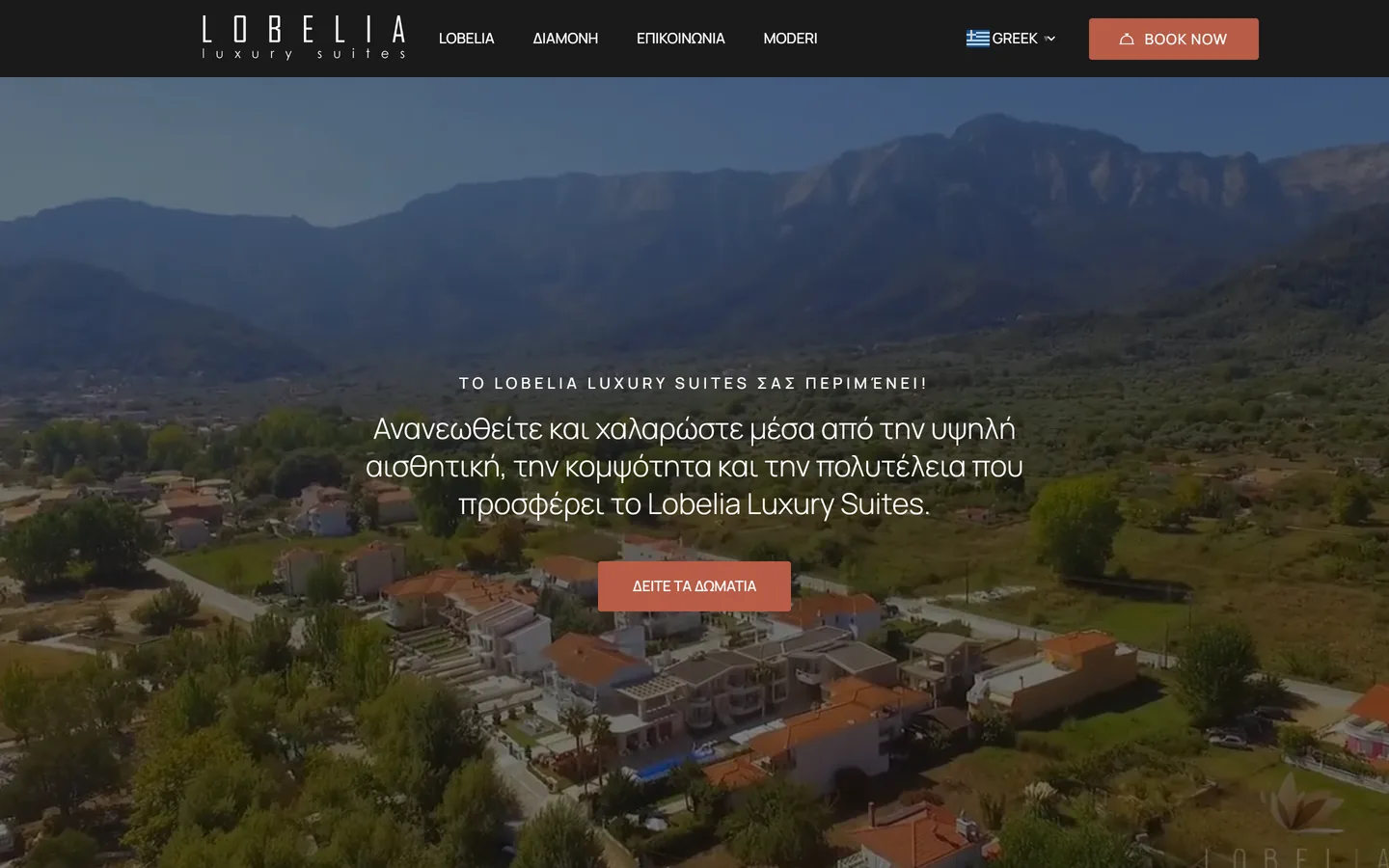 Accommodation
Lobelia Luxury Suites
SEO & technical SEOOur work in other sectors
SEO and speed on projects outside tourism, with published case studies.
Free guides for your hotel's SEO
What we use ourselves, out in the open.
Local SEOLocal SEO & Google Business Profile
How the map pack works for any business with a listing and reviews, including hotels.
Read → SEO & GEO
SEO & GEO: visibility on Google and in AI search
Our approach to search and generative engines, for every kind of business.
Read → Ads
AdsMeta & Google Ads Playbook 2026
The playbook we use in campaigns with real budgets.
Read →Specialised services for hotels
See each service in detail.